Fingertip Injury Reconstruction in Bangalore
Reliable reconstruction of crushed and amputated fingertips by Dr. Amrika Seshadri (MS, MCh), Plastic Surgeon with 11 years of standing. Using local advancement flaps (Atasoy V-Y, cross-finger) — not microvascular replantation — to restore length, sensation and natural nail growth as a same-day daycare procedure.
How is a crushed or amputated fingertip reconstructed in Bangalore?
Fingertip crush and amputation injuries are among the most common hand injuries in children and adults. At Dr. Amrika's Aesthetics on Sarjapura Main Road, the goal is a stable, painless, sensate fingertip that keeps its maximum length. Dr. Amrika Seshadri, a Plastic Surgeon with 11 years of standing, treats these by reconstructive salvage — local advancement flaps such as the Atasoy (V-Y) and cross-finger flap — rather than microvascular replantation, which has high failure rates in crushed tips. Most repairs are done under a digital nerve block as a same-day daycare procedure, taking roughly 45 minutes to 2 hours, with a return to desk work in 3 to 5 days. A lacerated nail bed is repaired to preserve normal nail growth. These injuries are reconstructive and usually insurance-covered; your exact plan and cost are confirmed at your consultation.
Reviewed by Dr. Amrika Seshadri (MS, MCh) · Last updated 17 September 2026
Why choose Dr. Amrika for Fingertip Reconstruction
Every surgery is conducted personally by Dr. Amrika (MS, MCh Plastic Surgery). Never delegated to assistants or medical generalists.
Reconstructive Salvage, Not Replantation
Dr. Amrika Seshadri does not perform microvascular replantation — in crushed or bruised fingertips it carries a high failure rate and a heavy post-operative burden. Instead, 11 years of practice go into reconstructive salvage with local flaps that give reliable, durable, pain-free tips and a fast return to work.
Length- and Sensation-Preserving Local Flaps
Atasoy V-Y advancement and cross-finger flaps transfer the patient's own vascularised, sensate tissue to cover exposed bone — 'like with like'. This maintains finger length, preserves the local nerve supply, and rebuilds a natural, cushioned pad for pinch and grip.
Precision Nail-Bed Micro-Repair
The nail is not merely cosmetic — it gives counter-pressure for grip. A lacerated nail bed is meticulously repaired under magnification so that, if the germinal matrix is intact, a smooth, normal nail regrows over 3 to 6 months, avoiding ridged or split nails.
Same-Day, Digital-Block Daycare Surgery
Most reconstructions are done under a digital nerve block in 45 minutes to 2 hours — you stay awake and comfortable, go home the same day, and avoid the hospital stay, blood-thinners and intensive monitoring that replantation demands.
Our Fingertip Reconstruction Protocol
A meticulous, multi-layer surgical protocol prioritizing structural aesthetics, minimal tissue trauma, and hidden incisions.
Evaluation & Radiographs
The injury mechanism (clean cut, crush or avulsion), vascular status, sensation and structural integrity are assessed, and AP / lateral X-rays check for a distal-phalanx fracture, DIP dislocation, or retained foreign bodies.
Tamai / Allen Classification
The defect is mapped to its Tamai zone and Allen type. This decides whether a local advancement flap, a cross-finger flap, or a conservative revision of the amputation site gives the best length and function.
Digital Block & Flap Design
Under a digital nerve block and a bloodless field, an Atasoy V-Y flap (for transverse or dorsal-oblique tips with exposed bone) or a cross-finger flap (for larger volar-oblique defects) is raised, preserving its deep nerve and vessel supply.
Advancement, Inset & Splinting
The flap is advanced or inset over the exposed bone without shortening the finger, then closed and protected in a splint that keeps the adjacent joints mobile. Cross-finger flaps are divided at a brief second stage around 2 to 3 weeks.
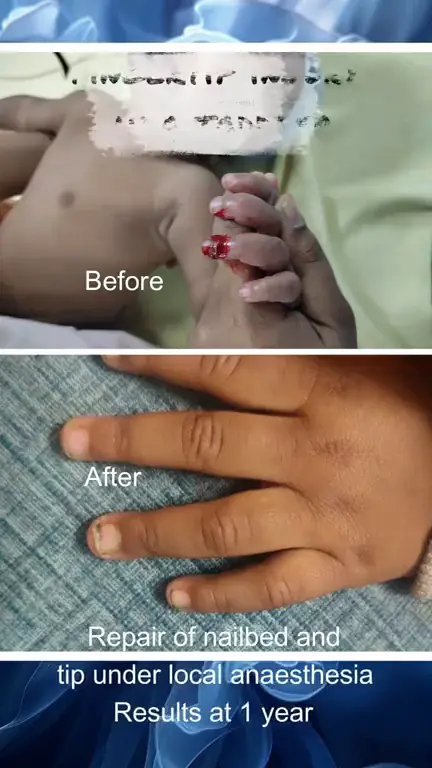
Documented cases: what this procedure involves.
Cases from Dr. Amrika’s own practice, published for patient education with each patient’s signed, anonymised consent. Identifying features are cropped or masked.
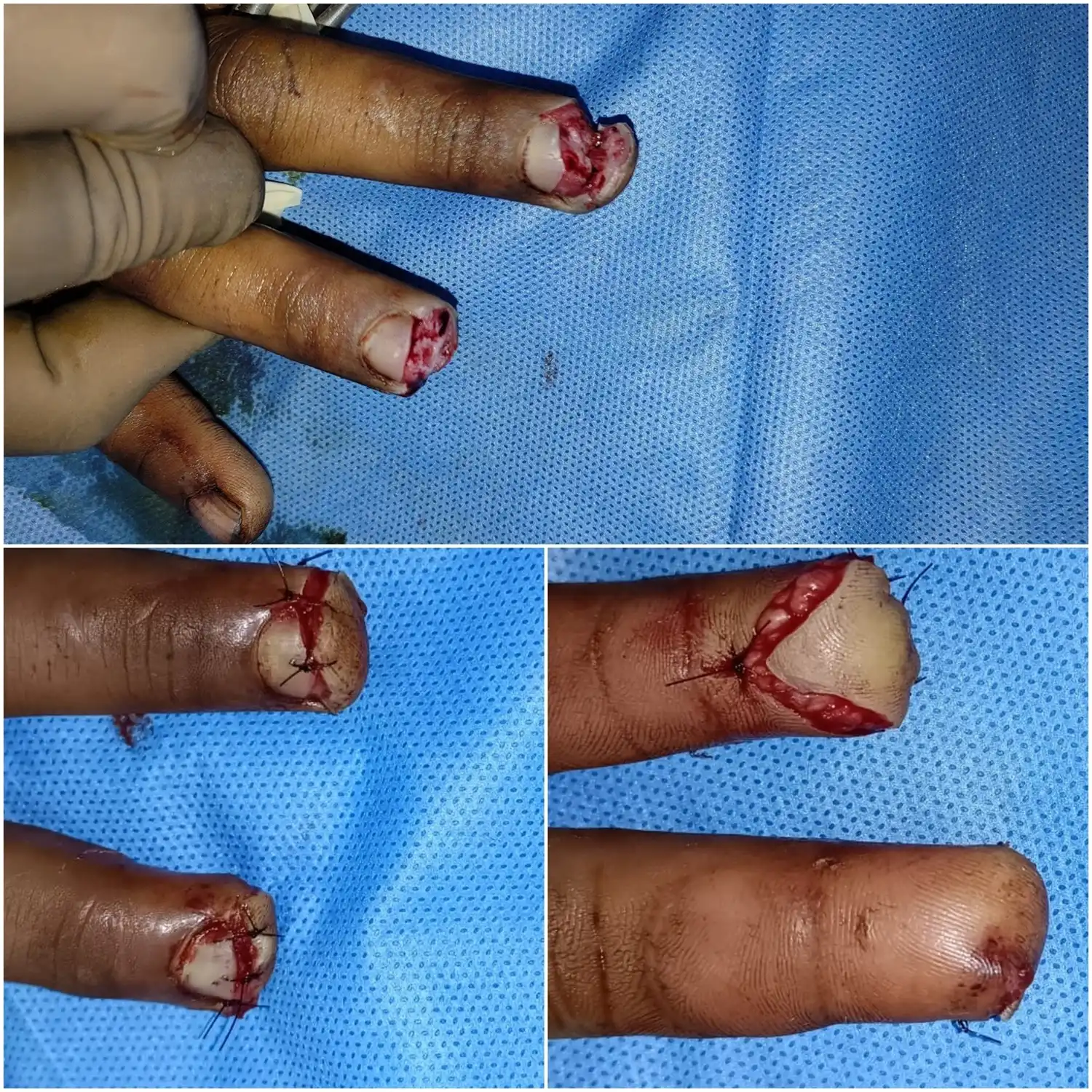
V-Y Advancement (Atasoy) Flap — Restoration of Finger Pulp & Contour
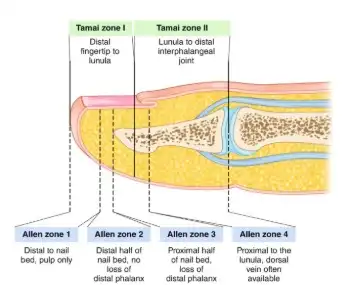
Allen Classification Analysis — Custom Surgical Flap Selection
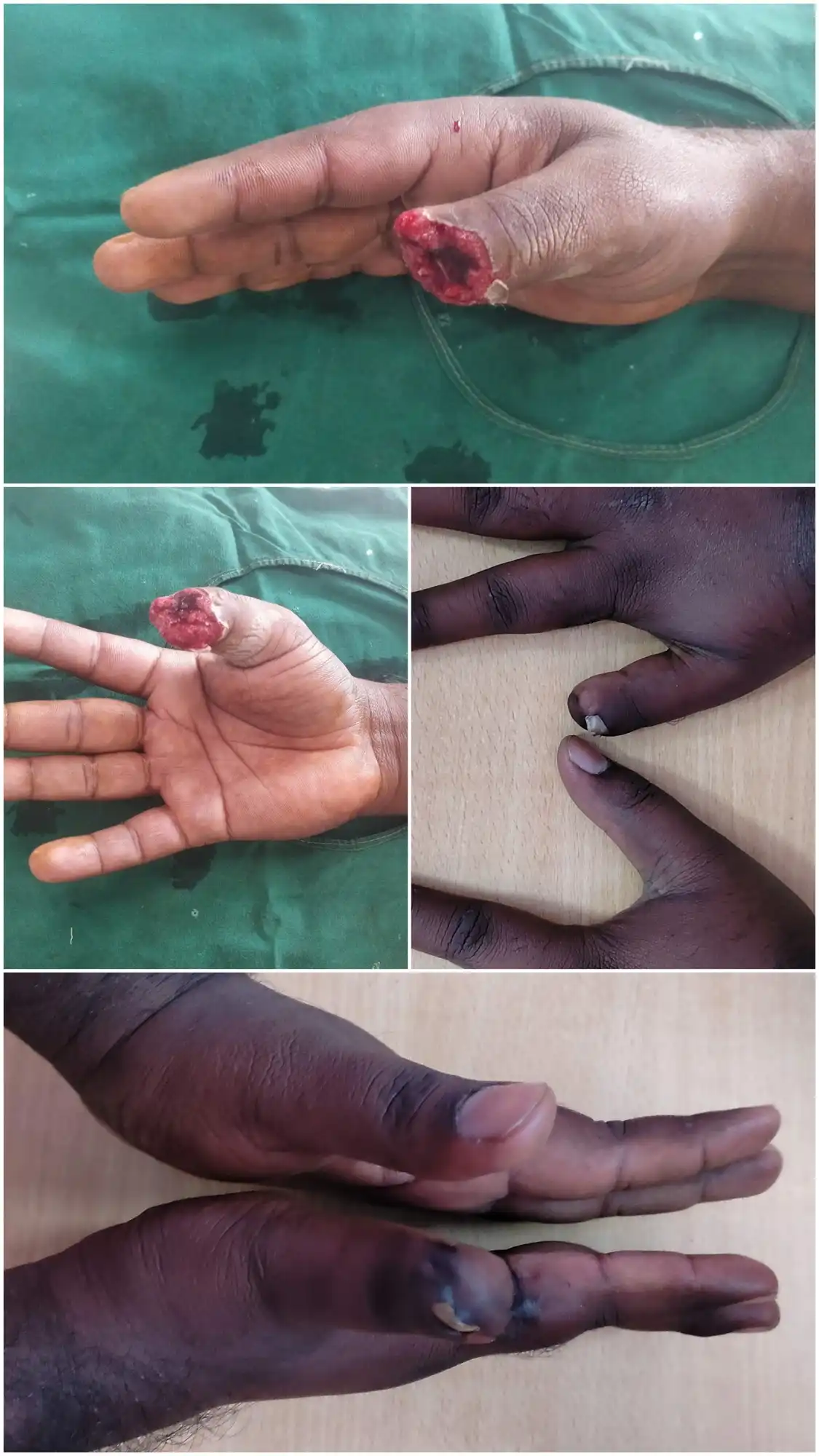
Vascularized Reconstruction — Sensory Preservation & Normal Nail Regrowth
Individual results vary — these images are illustrative, not a guarantee of outcome. Shared with patient consent.
Fingertip Reconstruction — Transparent Pricing
We believe healthcare pricing should be transparent. No hidden consumable line-items, no surprise theatre add-ons, and no aggregator markups.
Cost depends on the injury classification and the flap required — a simple nail-bed repair sits at the lower end, a two-stage cross-finger flap toward the upper end. Fingertip reconstruction is medically essential and covered by all major insurers, and we provide end-to-end reimbursement support. Indicative pricing only — reconstructive cases vary widely; your exact quote is personalised to your assessment and confirmed at your consultation.
- Surgeon fee — Dr. Amrika Seshadri operates personally
- Digital nerve-block anesthesia and sterile daycare OT
- Local advancement / cross-finger flap or nail-bed repair
- Ultra-fine micro-sutures and specialised dressings
- Protective finger splint and post-operative dressing changes
- End-to-end health-insurance reimbursement support
Recovery timeline & aftercare
Knowing what to expect at every milestone gives you complete peace of mind. Dr. Amrika directly oversees all follow-ups.
Elevation & Edema Control
Keep the hand elevated above heart level to reduce throbbing and swelling. The adjacent joints (PIP, MCP, wrist and elbow) are moved early to prevent stiffness in the rest of the hand while the flap settles.
Flap Check / Second-Stage Division
Dressings are reviewed and gentle active motion begins. For a cross-finger flap, a brief outpatient procedure around 2 to 3 weeks divides the two fingers and insets the flap into a new fingertip.
Desensitisation Therapy
As the flap heals, temporary hypersensitivity or numbness is retrained — rubbing the tip with varied textures, immersing it in rice, beans or sand, and alternating warm and cool contact, several times a day.
Scar Care & Return to Full Use
Silicone gel and circular scar massage keep the line soft and unstuck from the bone. Desk work resumes in 3 to 5 days and heavier manual work at 4 to 6 weeks; nail regrowth completes over 3 to 6 months.
Frequently asked questions
Straightforward, medically accurate answers directly from Dr. Amrika Seshadri.
Can a crushed or amputated fingertip be saved?+
Yes — but through reconstruction, not re-attachment. Dr. Amrika does not perform microvascular replantation; in crushed tips it has a high failure rate. Instead, local flaps (Atasoy V-Y, cross-finger) rebuild a stable, sensate, well-padded tip that keeps its length. If a part has been cut off, wrap it in damp sterile gauze, seal it in a bag and rest that bag on ice (never let the tissue touch ice directly), and bring it — it can sometimes serve as a 'spare-part' skin graft.
Why doesn't Dr. Amrika perform replantation?+
Replantation sews an amputated tip back by joining vessels often less than a millimetre wide — in crushed or bruised fingertips these clot easily, so it fails often and demands several days of hospitalisation, bed rest and blood-thinners. Over 11 years, Dr. Amrika has found that reconstructive salvage with local flaps aims for a durable, comfortable, functional fingertip with far less downtime and almost no risk of total tissue loss.
Will my fingernail grow back normally?+
If the injury is in Tamai Zone I and the germinal matrix under the cuticle is undamaged, the nail grows back — usually over 3 to 6 months. A cleanly repaired nail-bed laceration also tends to regrow smoothly. If the germinal or sterile matrix is severely damaged, some minor deformity such as ridging or a split nail can remain.
What anesthesia is used, and how long does surgery take?+
Most reconstructions are done under a digital nerve block — the finger is completely numb while you stay awake and comfortable, with no general-anesthesia recovery. A local flap such as the Atasoy takes about 45 to 75 minutes; the first stage of a cross-finger flap 1.5 to 2 hours. Both are daycare procedures, so you go home the same day.
How long will I be off work after surgery?+
Office and desk jobs: often 3 to 5 days, provided the hand is kept protected and elevated. Manual labour or heavy gripping: 4 to 6 weeks, to let the flap mature and gain full mechanical strength before heavy lifting or wet work.
Is fingertip surgery covered by insurance if the surgeon is a Plastic Surgeon?+
Yes. Although small in size, fingertip injuries carry real quality-of-life consequences, so nail-bed repairs, cross-finger flaps and local fingertip flaps are classed as reconstructive and medically essential — fully covered under all major insurers, not cosmetic. We provide end-to-end insurance reimbursement support for every patient who chooses us.
Watch Dr. Amrika explain this procedure
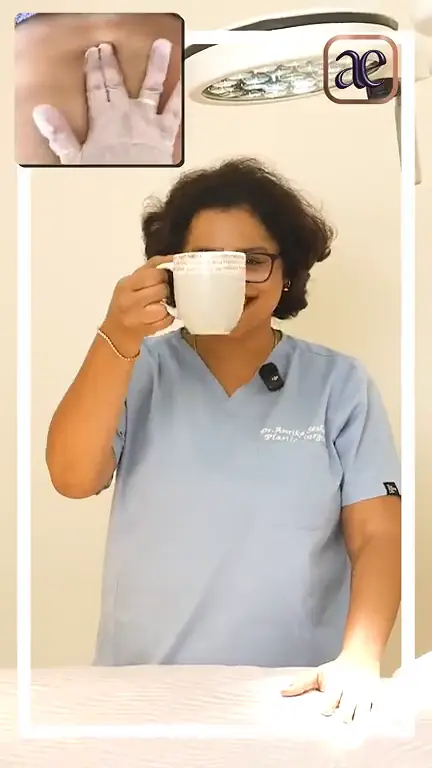
Direct surgical and anatomical guidance from Dr. Amrika Seshadri (MS, MCh Plastic Surgery).
Related procedures
Talk to the surgeon, not a call centre.
Speak directly with Dr. Amrika Seshadri (MS, MCh). Discuss your clinical goals in a private, unhurried consultation at Sarjapur Road.